Play Ransomware
- 129
- Global rank
- 184
- Month rank
- 175
- Week rank
Play aka PlayCrypt ransomware group has been successfully targeting corporations, municipal entities, and infrastruction all over the world for about three years. It infiltrates networks via software vulnerabilities, phishing links and compromised websites. The ransomware abuses Windows system services to evade detection and maintain persistence. Play encrypts user files and steals sensitive data while demanding a ransom.
- Ransomware
- Type
- Unknown
- Origin
- 1 March, 2022
- First seen
- 4 September, 2026
- Last seen
How to analyze Play Ransomware with ANY.RUN
IOCs
IP addresses
- 88.221.169.205
- 172.211.123.249
- 74.178.76.128
- 48.209.138.189
- 48.209.138.168
- 74.178.240.51
- 23.59.18.102
- 20.190.160.66
- 23.11.41.157
- 48.192.1.64
- 48.209.6.48
- 48.209.133.15
- 2.16.164.11
- 172.211.123.248
- 172.67.189.43
- 104.21.9.69
- 216.239.35.0
- 216.239.35.8
- 216.239.35.4
- 192.178.183.94
Hashes
- fe6db0a68179322f2a7ab3604a0a418cce0f3cae1541018c5093207df5a31138
- 9357ca9cf7373079035fcb410f92cb9b82fd23865c25b9b0504fe90f0b7dcb5d
- 86b437ba22e40b9821b7a6d18058ec91150bb9fe7a0ce2aa33029919ba7cca1f
- 42b9ed9c881b4844416e45d1d225a2c8808a0ddd994c796f909e2e6f7691b993
- 00eff28b7ad8b8f0ffbf921db7f0bbe42a811df1c97e183249f7fc3e5f0bf46b
- 9eba6876fd2a2b074ee2641a3289381a58a2b8dc117cf559ad8033961a02617f
- 6c23d75054bf66de33f6a85e20c1ba5014c7c6440b1df73a6ed29093cdf83454
- d36e681d5c6d7a369d5d38adaf25a830f41f13008de5d4f4dd67114a5d48e181
- 0e9bbd4c077581e3d394d80a3dba4a7cc658cbb4fc6a7073960b7c25a8bd43b0
- f76ab9991ce16bcc7bcf1c5f7af1993e63157717f91b345d6fc7448ed0fe7406
- 2744d826d3f0a8bafe15a763e8eddb0c04fa030b0ff65f3212940e07b81c3b2e
- e7f4718611af0e39790fa348a9fc698a792f4d62e69b0b9f48136a7d008c5f80
- a64b72e7292c405def2bee947dbec3bf3b991eb8fd35c65c9eab86396aa2b348
- fb4768a34ecdfaae4d5e18b11b79e520a24dd10ce3dceb623e18c4fd55c0dee2
- c046770bfdba2e6b518bfdb210bc4832923f1732caae81a0145f2e325037afc1
- 217d993083cc158a15492b14219f1dccd65f2a9b4cf2ae3e04ca73897d6515c5
- f211dbc5f7496533594e4a37cd912fe5149cf78d302dd2839cb3668df8275890
- b75646fe6abeb5793bb14d0c6666d57d21e7769fcb6e383af8b56abc89eaf90d
- 7297aa9fe5152e86ac6285e9ae0339dcaee7aab14dfb45960feaca00dedfc444
- 2b8bdfc52835221e2593c0a91303d4156e149b3c6a94de11d60750760273355f
Domains
- settings-win.data.microsoft.com
- activation-v2.sls.microsoft.com
- crl.microsoft.com
- self.events.data.microsoft.com
- ocsp.digicert.com
- www.microsoft.com
- client.wns.windows.com
- google.com
- nexusrules.officeapps.live.com
- login.live.com
- slscr.update.microsoft.com
- fe3cr.delivery.mp.microsoft.com
- go.microsoft.com
- time.android.com
- wswswswsydl.hloon.sbs
- connectivitycheck.gstatic.com
- staging-remoteprovisioning.sandbox.googleapis.com
- www.google.com
- firebaseinstallations.googleapis.com
- x.clarity.ms
URLs
- http://ocsp.digicert.com/mfewtzbnmeswstajbgurdgmcgguabbq50otx%2fh0ztl%2bz8sipi7wewvxdlqqutijuibiv5unu5g%2f6%2brks7qyxjzkceaz1vqyrvgl0erhqlcpm8gy%3d
- http://crl.microsoft.com/pki/crl/products/microoceraut2011_2011_03_22.crl
- http://www.microsoft.com/pkiops/crl/micsecserca2011_2011-10-18.crl
- http://www.microsoft.com/pkiops/crl/microsoft%20ecc%20update%20secure%20server%20ca%202.1.crl
- https://settings-win.data.microsoft.com/settings/v3.0/wsd/updatehealthtools?os=windows&osver=10.0.19041.1.amd64fre.vb_release.191206-&sku=48&deviceclass=windows.desktop&locale=en-us&deviceid=s:bad99146-31d3-4ec6-a1a4-be76f32ba5d4&sampleid=s:95271487&appver=10.0.19041.3626&flightring=retail&telemetrylevel=1&hidovergattreg=c%3a%5cwindows%5csystem32%5cdriverstore%5cfilerepository%5chidbthle.inf_amd64_9610b4821fdf82a5%5cmicrosoft.bluetooth.profiles.hidovergatt.dll&appver=&processoridentifier=amd64%20family%2023%20model%201%20stepping%202&oemmodel=dell&updateoffereddays=4294967295&processormanufacturer=authenticamd&installdate=1661339444&oemmodelbaseboard=&branchreadinesslevel=cb&oemsubmodel=j5cr&isclouddomainjoined=0&deferfeatureupdateperiodindays=30&isdeviceretaildemo=0&flightingbranchname=&osuilocale=en-us&devicefamily=windows.desktop&wuclientver=10.0.19041.3996&uninstallactive=1&isflightingenabled=0&osskuid=48&processorclockspeed=3094&totalphysicalram=6144&securebootcapable=0&app=sedimentpack&processorcores=6¤tbranch=vb_release&installlanguage=en-us&deferqualityupdateperiodindays=0&oemname_uncleaned=dell&tpmversion=0&primarydisktotalcapacity=262144&installationtype=client&attrdataver=186&processormodel=amd%20ryzen%205%203500%206-core%20processor&isedgewithchromiuminstalled=1&osversion=10.0.19045.4046&ismdmenrolled=0&activationchannel=retail&firmwareversion=a.40&trendinstalledkey=1&osarchitecture=amd64&defaultuserregion=244&updatemanagementgroup=2
- https://login.live.com/rst2.srf
- http://connectivitycheck.gstatic.com/generate_204
- http://wswswswsydl.hloon.sbs/
- https://www.google.com/generate_204
- https://staging-remoteprovisioning.sandbox.googleapis.com/v1:fetcheekchain
- https://staging-remoteprovisioning.sandbox.googleapis.com/v1:signcertificates?challenge=aaabn9am1kwbilsty737uqfy7il3g3bfcm_6yhu=&request_id=5a088820-7b5f-4454-aa4d-9631d05cb863
- https://staging-remoteprovisioning.sandbox.googleapis.com/v1:signcertificates?challenge=aaabn9ajtzqbilstyzxs2fq0cxwydjzpllsji4u=&request_id=1893a808-1710-4ad4-b144-3a3c68ab1080
- http://www.google.com/gen_204
- http://clients2.google.com/time/1/current?cup2key=9:pf_lhznlvjceiuw-1tfmh00pif7b_khbgsi28okwx_4&cup2hreq=e3b0c44298fc1c149afbf4c8996fb92427ae41e4649b934ca495991b7852b855
- https://we.tl/t-q1wagrfjbdbkmaam
- https://accounts.google.com/listaccounts?gpsia=1&source=chromiumbrowser&laf=b64bin&json=standard
- https://staging-remoteprovisioning.sandbox.googleapis.com/v1:signcertificates?challenge=aaabn88squabilsty3pmha_3oy3hejuk55ovda4=&request_id=a9791f8e-097c-4150-8aee-f843105a53f0
- https://wetransfer.com/downloads/33e8a8205cba8277c92e381c9a5869ed20260804234448/555556?t_exp=1786146288&t_lsid=bb0a21c4-a7a3-4856-9969-31fe0eb8b4c8&t_network=link&t_rid=z29vz2xllw9hdxromnwxmdm0otu3mjy0mdy4mdgwmja0ntu=&t_s=download_link&t_ts=1785887088
- https://cdn.wetransfer.com/_next/static/chunks/0upm7txdyrg0s.css
- https://cdn.wetransfer.com/_next/static/chunks/22uc4p-ktsw3g.css
Last seen at
- 03d571d0532da90f4e713f0bcdf8db452f8a82a8
- 260404-rzjcxscw3t_pw_infected.zip
- 260404-rzjcxscw3t_pw_infected.zip
- a782b9d82f21fb3aac32de6d24a8730eb39f1bd34bc590ca03fa6bb527c74fec.zip
- a782b9d82f21fb3aac32de6d24a8730eb39f1bd34bc590ca03fa6bb527c74fec.zip
- a782b9d82f21fb3aac32de6d24a8730eb39f1bd34bc590ca03fa6bb527c74fec.exe
- a782b9d82f21fb3aac32de6d24a8730eb39f1bd34bc590ca03fa6bb527c74fec.exe
- a782b9d82f21fb3aac32de6d24a8730eb39f1bd34bc590ca03fa6bb527c74fec.zip
- a782b9d82f21fb3aac32de6d24a8730eb39f1bd34bc590ca03fa6bb527c74fec.zip
- a782b9d82f21fb3aac32de6d24a8730eb39f1bd34bc590ca03fa6bb527c74fec.zip
What is Play ransomware?
Play aka PlayCrypt is relatively new yet already notorious ransomware group active since mid-2022. It has impacted a wide range of businesses and critical infrastructure in North America, South America, and Europe.
It is based on double extortion technique and has intermittent encryption as its signature feature. Partial encryption is completed much faster, besides, it prevents detection by security solutions that monitor files for extensive modifications.
It infiltrates the targeted system by exploiting vulnerabilities in public-facing applications, such as Microsoft Exchange Server. It is also distributed via phishing emails containing malicious attachments or links. Malicious ads and compromised websites has also been detected as distribution vehicles.
To move laterally within the network and deploy the ransomware payload, it abuses the legitimate tools and built-in system utilities (e.g., PowerShell, PsExec, Cobalt Strike).
After exfiltrating sensitive data, the ransomware encrypts files, adds the .play extension, and leaves a ransom note in each affected directory containing instructions on how to pay the ransom.
Play ransomware uses anti-analysis techniques to evade detection by security software, creates scheduled tasks and modifies registry entries to maintain persistence.
Play ransomware technical details
Play Ransomware is equipped with advanced capabilities focused on maximizing impact on the victims’ infrastructure:
- Double Extortion: Data encryption and theft for increased ransom leverage.
- Partial File Encryption: Evades detection, speeds encryption by encrypting file portions rather than entire files.
- Security Disabling: Disables security systems to facilitate encryption and maintain persistence.
- Log Removal: Removes system logs to obscure activity and hinder forensics.
- Lateral Movement: Spreads within networks, increasing attack scope and leverage.
- Network Reconnaissance: Uses NetScan for network topology and target identification to enable lateral movement.
- Credential Dumping: Employs Mimikatz for credential extraction to facilitate privilege escalation and lateral movement.
- Privilege Escalation: Leverages publicly available Windows Privilege Escalation Awesome Scripts for privilege escalation, enabling system-level access.
- Remote Control: Utilizes AnyDesk and Cobalt Strike for persistent remote access, command execution, and potential data exfiltration.
Play execution process
Let’s upload the Play Ransomware to ANY.RUN’s Interactive Sandbox for analysis to see how it operates.
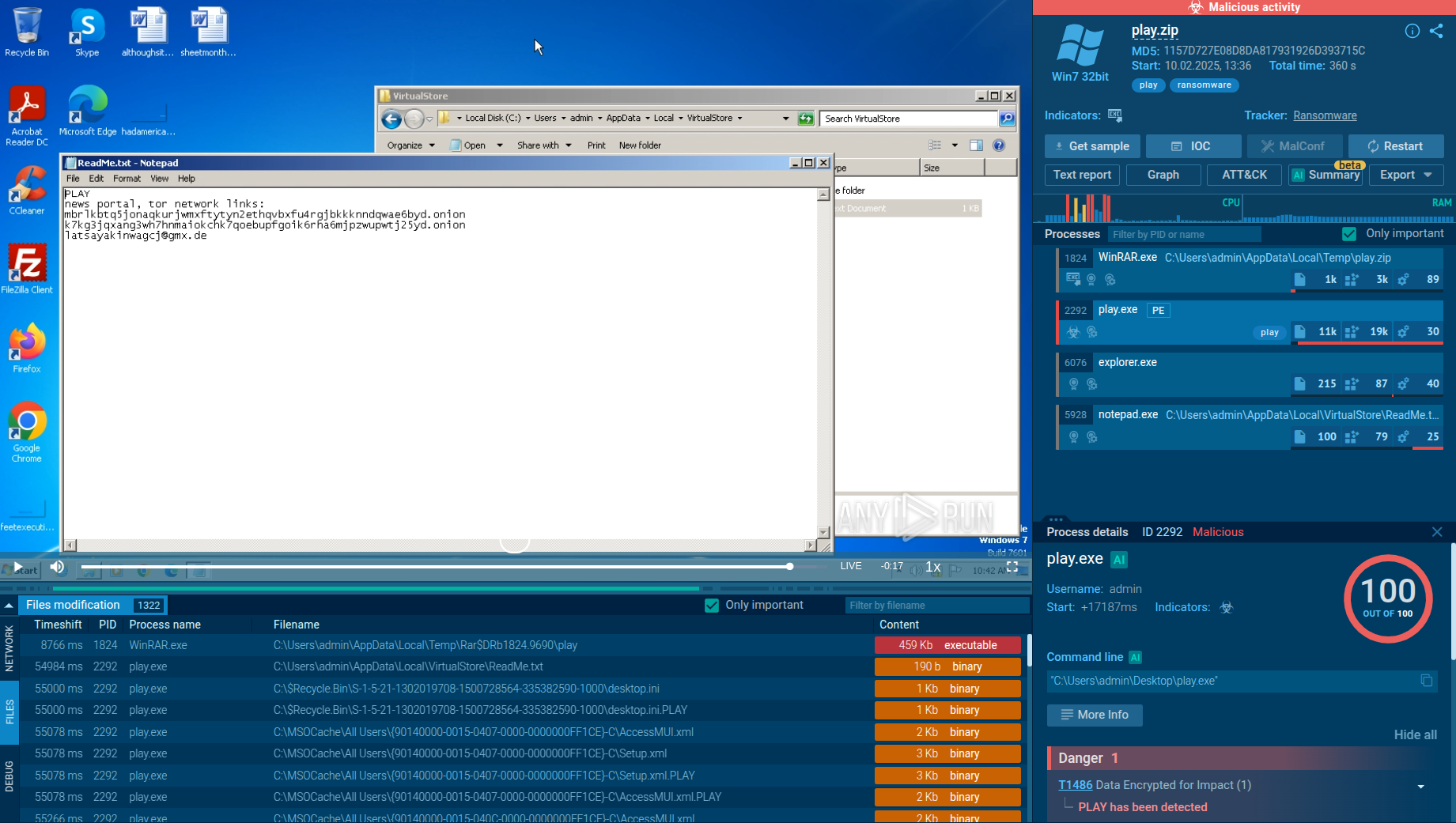
A typical Play ransomware attack begins with gaining initial access to the victim’s network via exploiting public-facing applications or abusing valid accounts.
Once inside the targeted environment, the malware focuses on stealth by heavily relying on Living Off the Land Binaries (LOLBins). To facilitate lateral movement and execute files, Play may use command-and-control applications like Cobalt Strike or SystemBC.
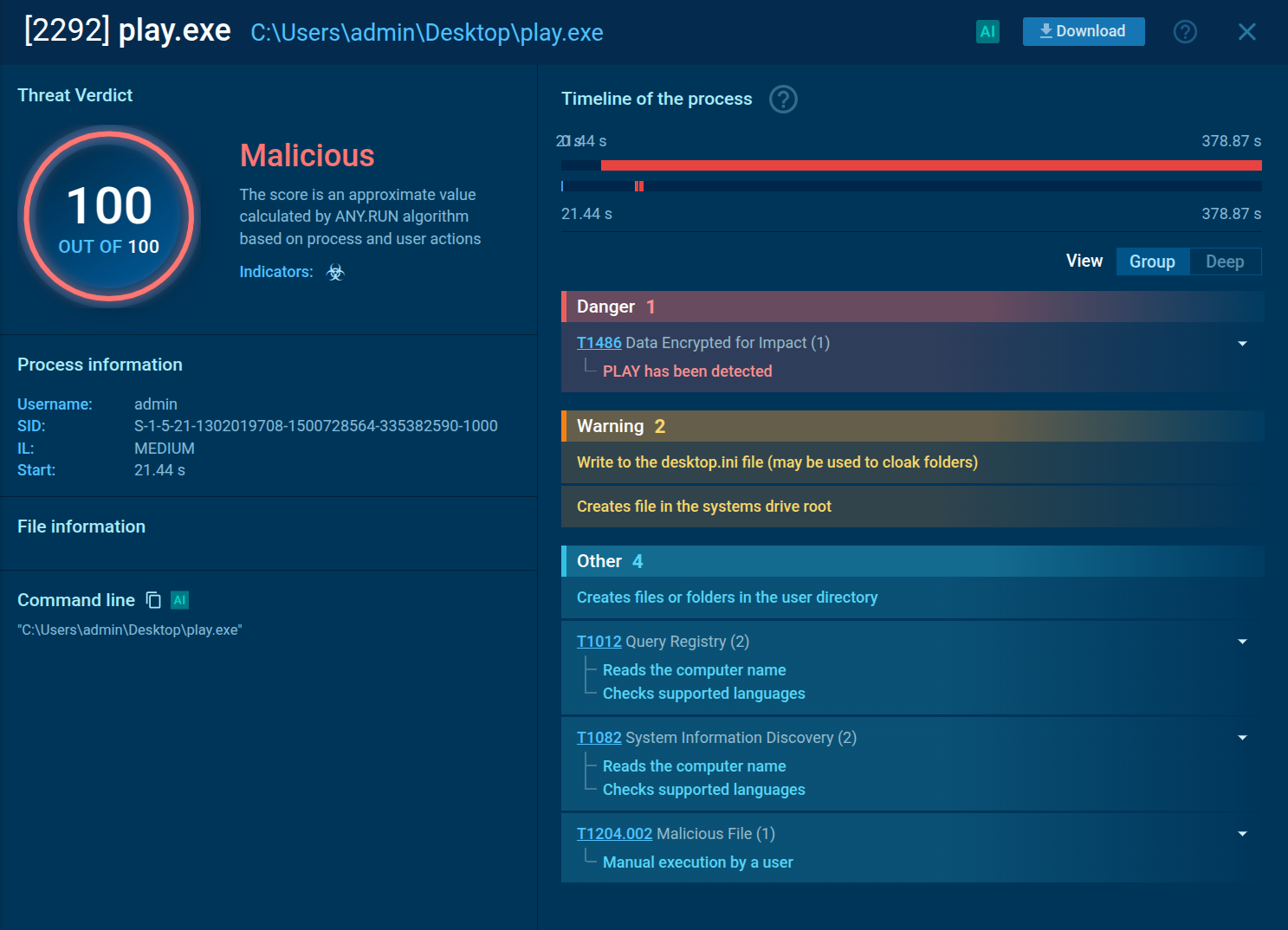
Before encrypting files, Play ransomware operators exfiltrate data. They do this by splitting compromised data into segments, compressing files, and transferring them to actor-controlled accounts.
After exfiltration, the ransomware encrypts files using an AES-RSA hybrid approach with intermittent encryption while skipping system files.
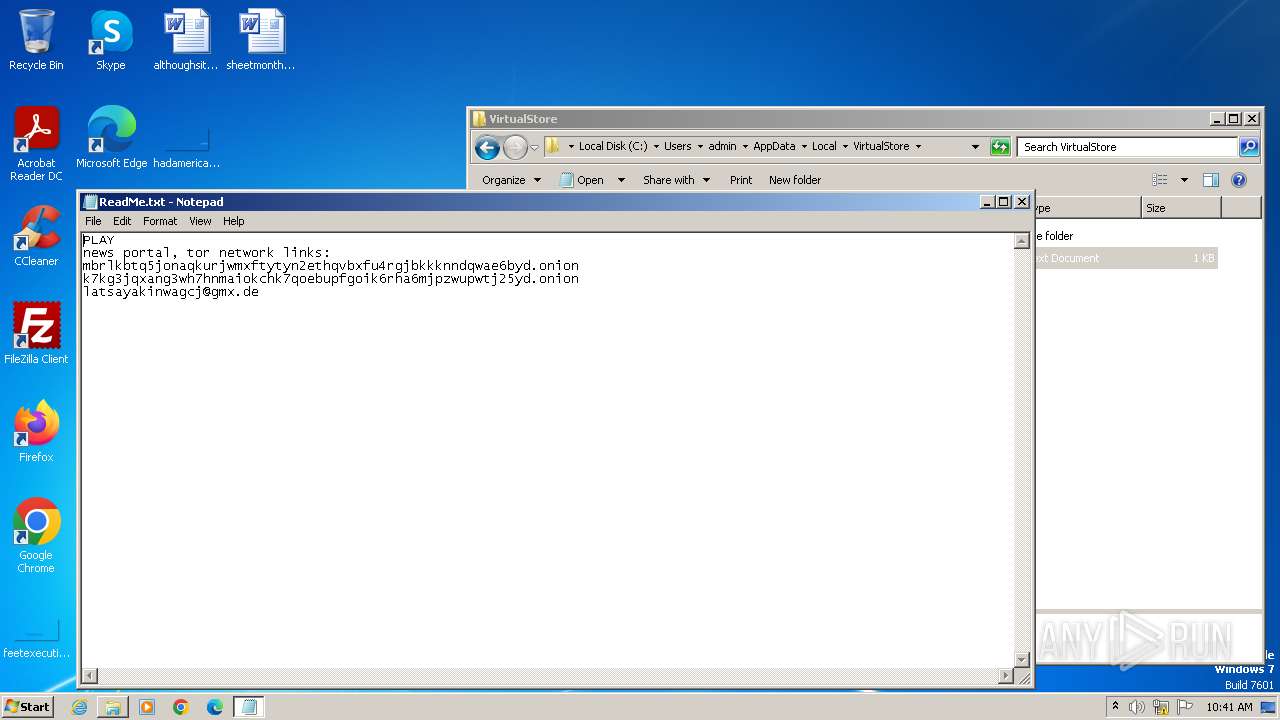
Encrypted files are appended with the .play extension, and a ransom note named ReadMe.txt is placed in the file directory on the C:\ partition.
Collect Cyber Threat Intelligence on Play Ransomware
To get the most current information about Play Ransomware, use Threat Intelligence Lookup. It contains data extracted from millions of public malware analyses conducted in ANY.RUN’s Interactive Sandbox.
You can use over 40 different search parameters, including specific IPs, domains, file names, or even mutexes. Using these filters, you can quickly gather important details about threats like Play Ransomware.
For example, if you were investigating Play Ransomware, you could start by directly searching for its name within the Threat Intelligence Lookup. Or, if you had other clues like unique file codes (hashes) or website connections it uses, you could search with those instead.
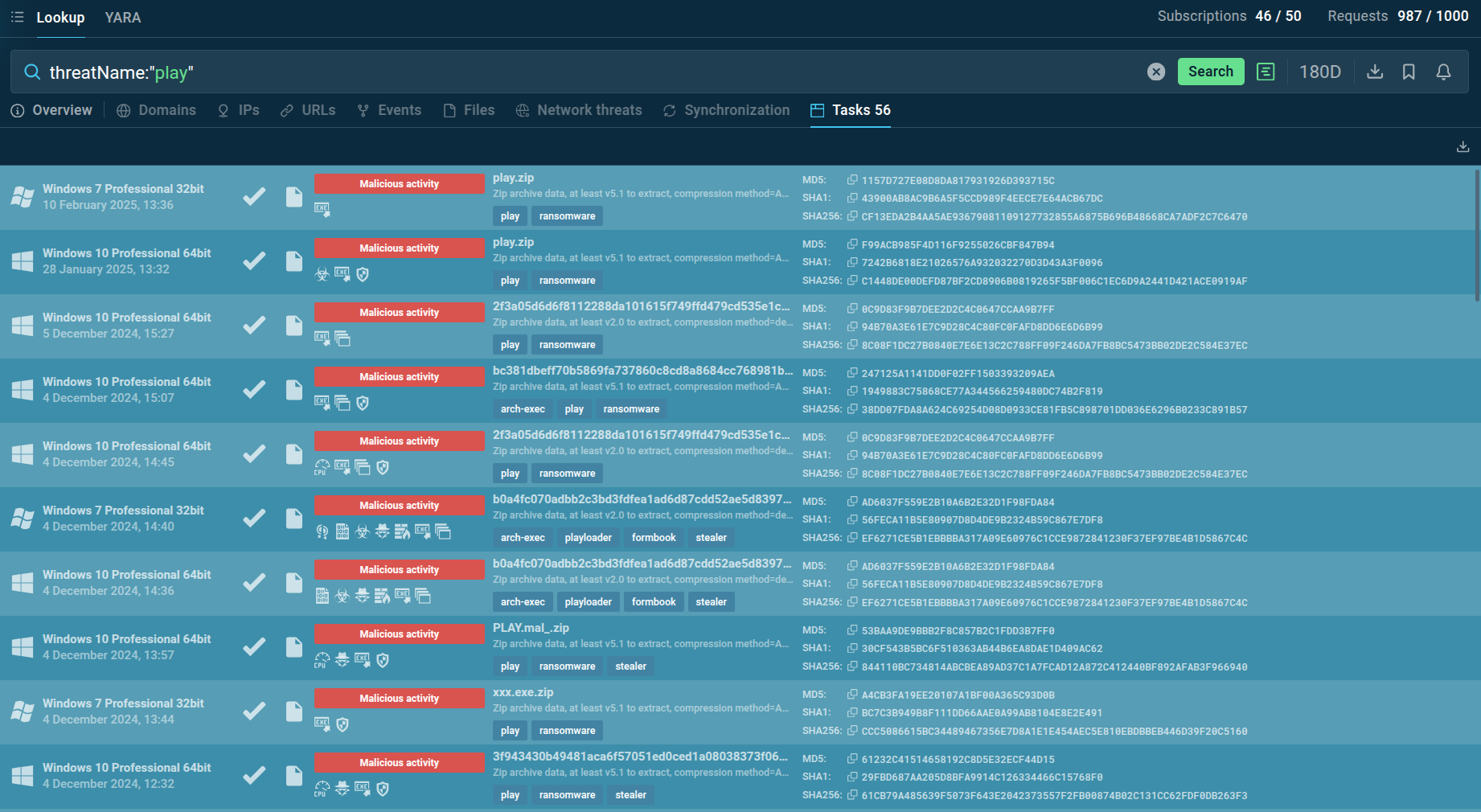
A simple and effective search would be to use the search term: threatName:"Play". This type of search will show you a list of sandbox reports associated with Play Ransomware. You can then explore these reports to get a deep understanding of exactly how this ransomware works and what it does.
Play distribution methods
Play Ransomware commonly gains initial access through several attack vectors. Compromised Remote Desktop Protocol (RDP) servers are a frequent entry point, often due to weak security configurations. Attackers exploit known vulnerabilities like CVE-2020-12812 in RDP services to bypass authentication and gain unauthorized system access.
Another prevalent method involves exploiting CVE-2022-41040, the ProxyNotShell vulnerability in Microsoft Exchange, allowing for remote code execution directly on vulnerable servers.
Conclusion
Play Ransomware poses a serious risk to organizations. Its blend of advanced techniques, such as partial encryption and lateral movement, coupled with readily exploitable entry points like RDP and VPN vulnerabilities, requires comprehensive security attention.
To prevent Play Ransomware infections, organizations can analyze suspicious files and URLs in ANY.RUN's Interactive Sandbox. The service provides fast insights into the malicious behavior and allows users to manually engage with threats in a safe environment just like on a standard computer.
Other malware & phishing threats
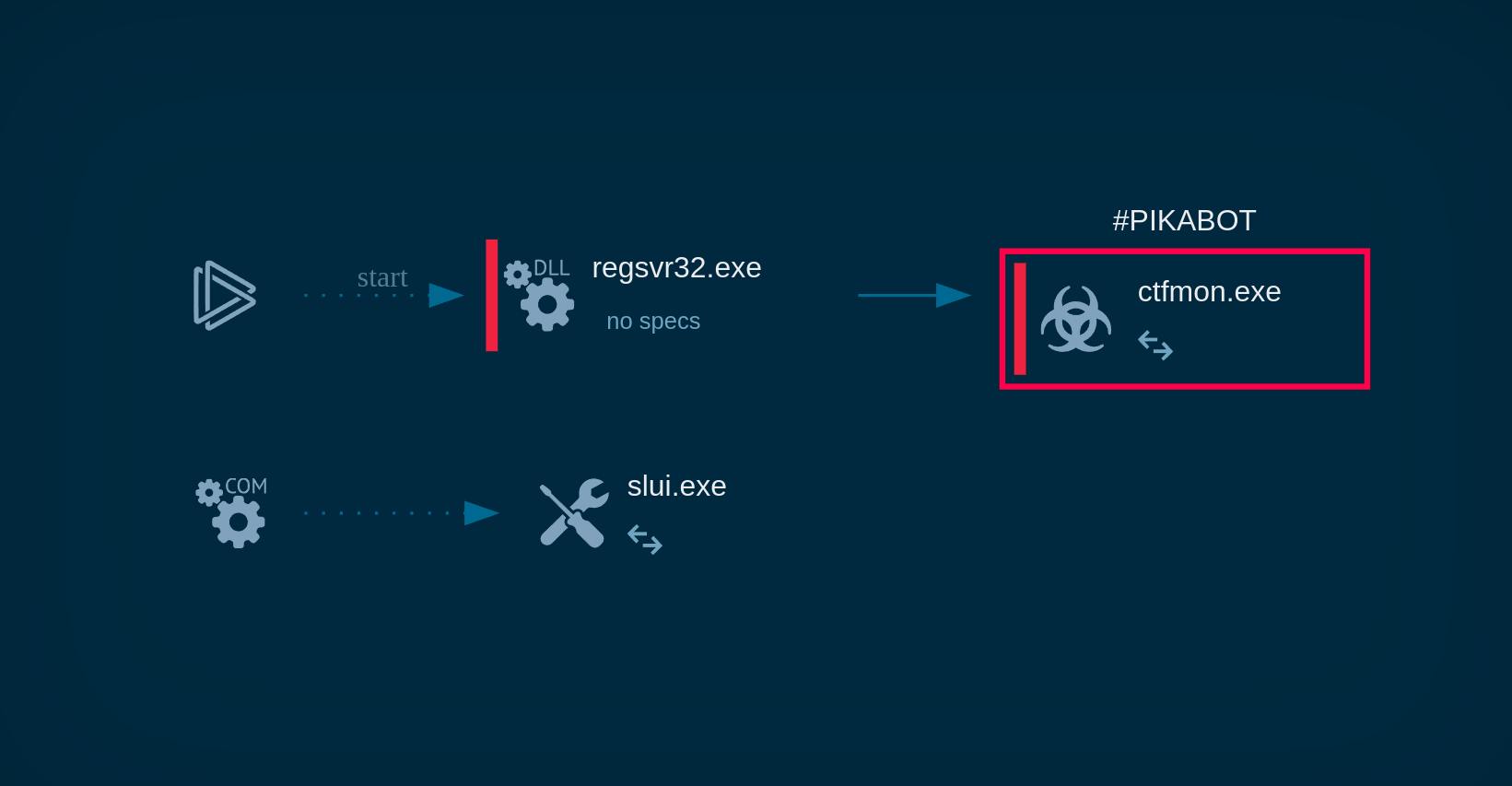 PikabotPikabot is a trojan malware with a focus on loader capabilities. Pikabot is also used for other activities, such as executing commands on the infected system. The earlier versions of the malware made use of extensive code obfuscation to evade detection. Upon infection, it collects system information and sends it to command-and-control servers.
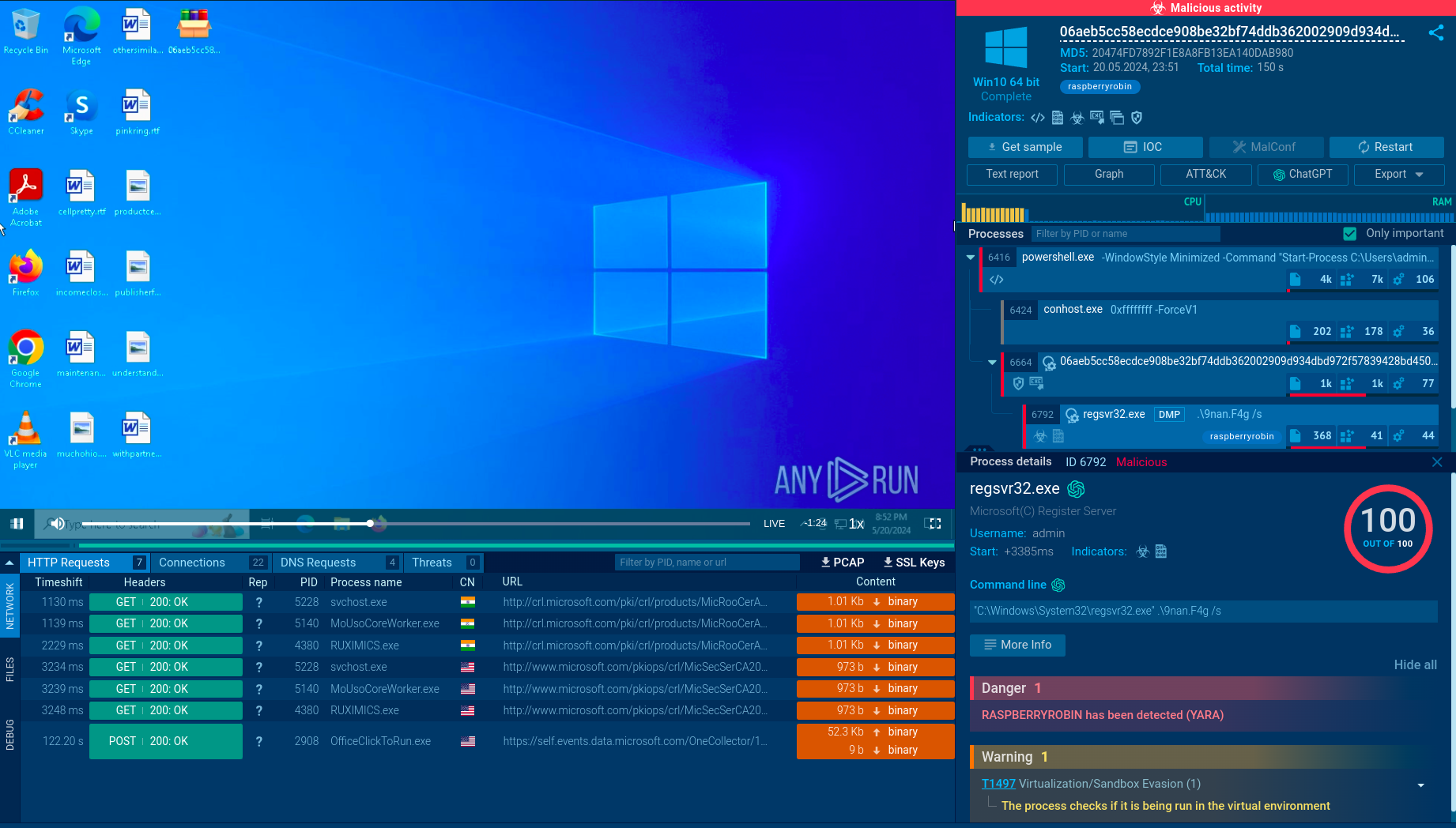 Raspberry RobinRaspberry Robin is a trojan that primarily spreads through infected USB drives and exploits legitimate Windows commands. This malware is known for its advanced obfuscation techniques, anti-debugging mechanisms, and ability to gain persistence on infected systems. Raspberry Robin often communicates with command-and-control servers over the TOR network and can download additional malicious payloads.
 SocelarsSocelars is an information-stealing Trojan (often categorized as spyware/stealer) that focuses on collecting sensitive data from Windows systems, with standout reporting around Facebook Ads Manager and session cookie theft.
Unlike “noisy” malware that immediately breaks something, Socelars quietly converts a single infected machine into access: logged-in sessions, business account data, and pathways to monetization.
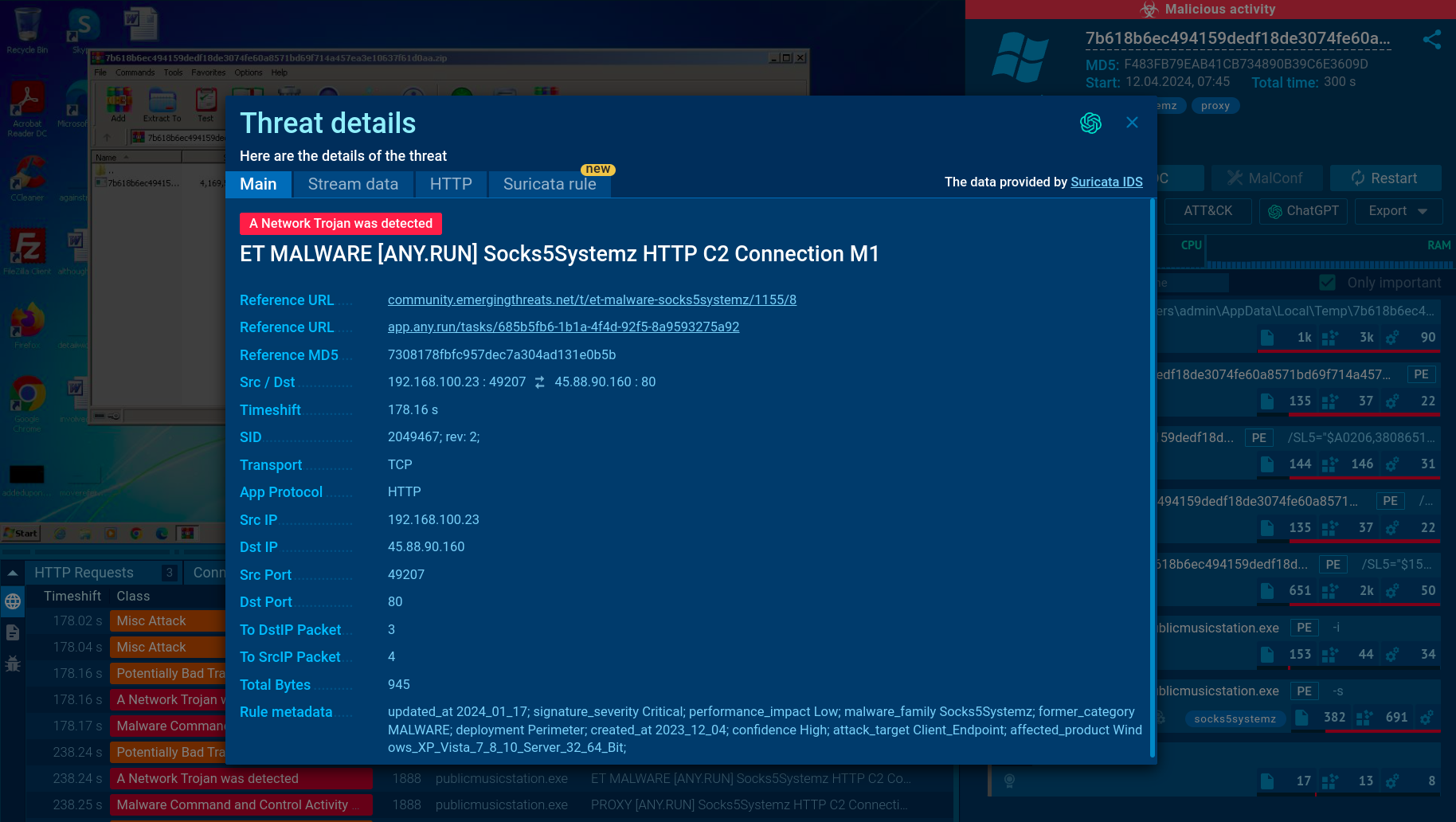 Socks5SystemzSocks5systemz is a botnet that utilizes its infection capabilities to establish a network of compromised devices. These devices are then used to forward malicious traffic. The criminals behind this malware sell access to the infected endpoints to other threat actors. Socks5systemz maintains control over thousands of devices and communicates with them using specific commands.
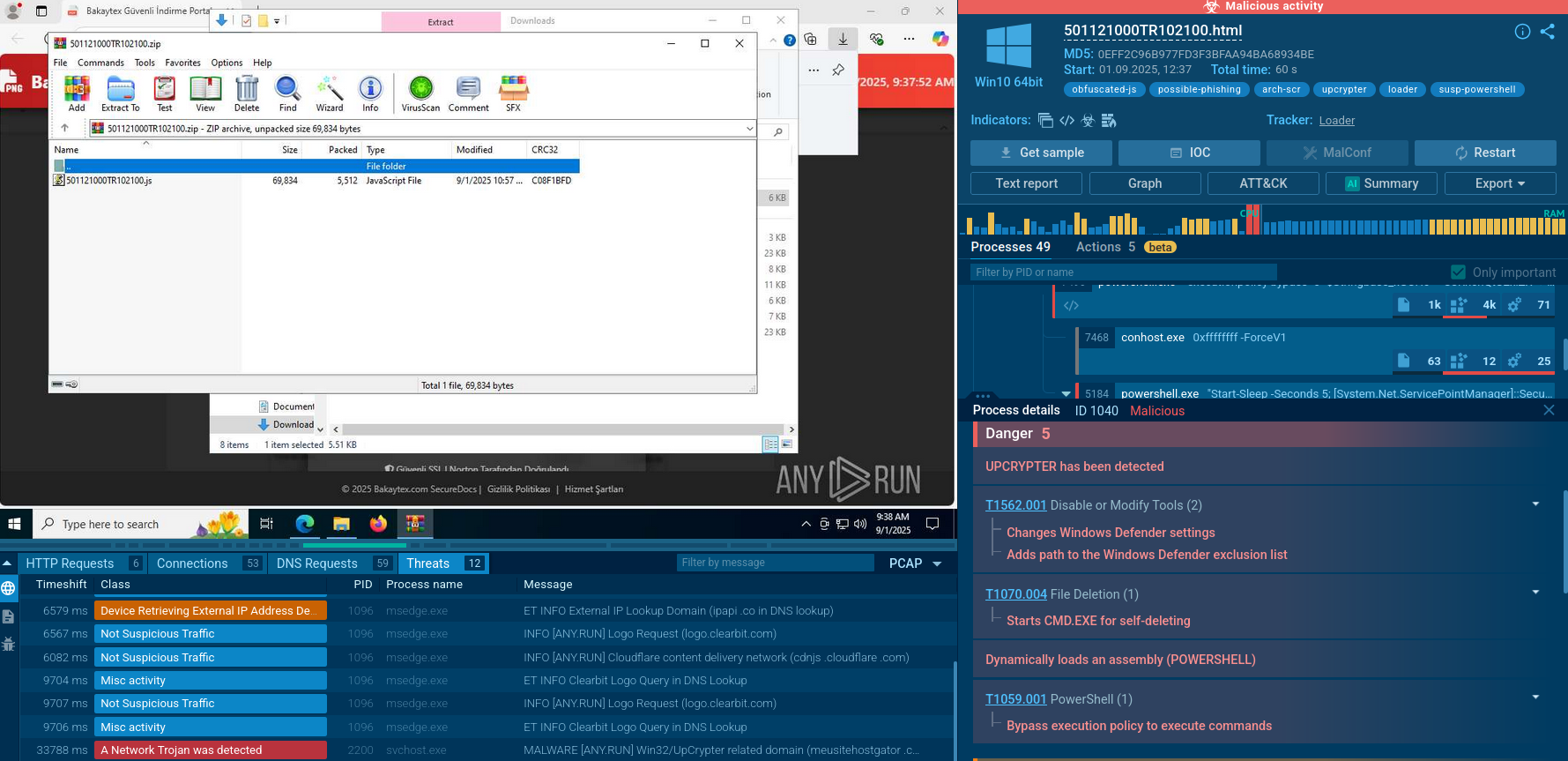 UpCrypterUpCrypter is a sophisticated malware loader that functions as a delivery mechanism for remote access tools. Distributed through global phishing campaigns targeting Windows systems, this actively maintained tool serves as the central framework for deploying various RATs including PureHVNC, DCRat, and Babylon RAT, enabling attackers to establish persistent remote control over compromised systems.
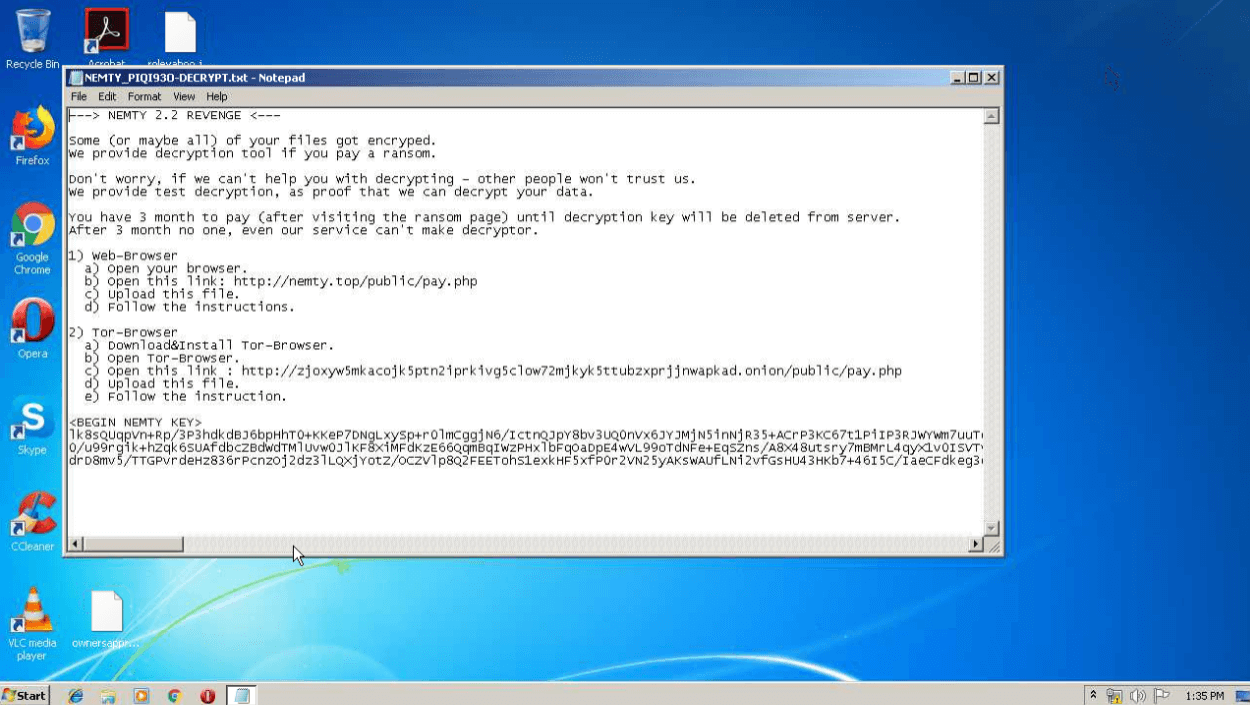 NemtyNemty is ransomware with an unusually complex encryption algorithm. This malware encrypts user files and demands money so that they can be unlocked again. It may be connected to other famous ransomware, but we don’t know for sure.