Ramnit
- 121
- Global rank
- 124
- Month rank
- 126
- Week rank
Ramnit is a highly modular banking trojan and worm that evolved from a file-infecting virus into a powerful cybercrime tool. It specializes in financial fraud, credential theft, remote access, and malware delivery, being a serious threat to businesses and individuals. First spotted in 2010, Ramnit became popular after the 2014 takedown of the GameOver Zeus botnet, as cybercriminals sought alternatives for banking fraud.
- Trojan
- Type
- Unknown
- Origin
- 1 May, 2010
- First seen
- 18 October, 2026
- Last seen
How to analyze Ramnit with ANY.RUN
IOCs
IP addresses
- 182.155.217.215
- 46.144.28.128
- 196.122.7.164
- 124.198.161.123
- 68.241.105.76
- 209.200.250.159
- 210.148.81.53
- 160.121.4.126
- 118.167.189.193
- 142.181.183.65
- 97.189.196.122
- 43.228.157.73
- 223.58.25.119
- 60.142.139.143
- 196.135.115.157
- 60.142.189.2
- 210.164.172.196
- 39.111.34.44
- 197.141.233.183
- 45.34.140.2
Hashes
- f7e4aae30ab2bda60bead5fd5a29a36685d768df007d3399d3047768babae200
- a32e0a83001d2c5d41649063217923dac167809cab50ec5784078e41c9ec0f0f
- cfe72034a9f298fb79a6c1f2302673bb449c826d446b3efafdde95e6c48dc3ca
- ceebae7b8927a3227e5303cf5e0f1f7b34bb542ad7250ac03fbcde36ec2f1508
- 3ad2dc318056d0a2024af1804ea741146cfc18cc404649a44610cbf8b2056cf2
- 226eec4486509917aa336afebd6ff65777b75b65f1fb06891d2a857a9421a974
- 602c4c7482de6479dd2e9793cda275e5e63d773dacd1eca689232ab7008fb4fb
- 138c240382304f350383b02ed56c69103a9431c0544eb1ec5dcd7dec7a555dd9
- 0f404764d07a6ae2ef9e1e0e8eaac278b7d488d61cf1c084146f2f33b485f2ed
- bcc0e6458249433e8cba6c58122b7c0efa9557cbc8fb5f9392eed5d2579fc70b
- 4d0bd3228ab4cc3e5159f4337be969ec7b7334e265c99b7633e3daf3c3fcfb62
- d95aed234f932a1c48a2b1b0d98c60ca31f962310c03158e2884ab4ddd3ea1e0
- b371af3ce6cb5d0b411919a188d5274df74d5ee49f6dd7b1ccb5a31466121a18
- 4f7ed27b532888ce72b96e52952073eab2354160d1156924489054b7fa9b0b1a
- 8e015cdf2561450ed9a0773be1159463163c19eab2b6976155117d16c36519da
- a5b733e3dce21ab62bd4010f151b3578c6f1246da4a96d51ac60817865648dd3
- 91508ab353b90b30ff2551020e9755d7ab0e860308f16c2f6417dfb2e9a75014
- c43075b1d2386a8a262de628c93a65350e52eae82582b27f879708364b978e29
- 5d9767d8cca0fbfd5801bff2e0c2adddd1baaaa8175543625609abce1a9257bd
- c23fe8d5c3ca89189d11ec8df983cc144d168cb54d9eab5d9532767bcb2f1fa3
Domains
- rr4---sn-aj5go5-53.gvt1.com
- dubacdn.cmcmcdn.com
- cl.ssouy.com
- clients2.google.com
- vejnqoajk1soxy1x.public.blob.vercel-storage.com
- accounts.google.com
- ojang.pe.kr
- omex.cdn.office.net
- icanhazip.com
- hnjgdl.geps.glodon.com
- d3cciiowg5l3jx.cloudfront.net
- officeclient.microsoft.com
- media.githubusercontent.com
- stats.pinaview.com
- clientservices.googleapis.com
- cd001.www.duba.net
- down.qqfarmer.com.cn
- crl.microsoft.com
- sg123.net
- www.google.com
URLs
- http://crl.microsoft.com/pki/crl/products/microoceraut2011_2011_03_22.crl
- http://ocsp.digicert.com/mfewtzbnmeswstajbgurdgmcgguabbtrjrydryt%2bapf3gspypfhbxr5xtqqus9tippmhxdiunkhmewnpyim8s8yceajtxtab8my1oj8mfwpz%2f7y%3d
- http://www.microsoft.com/pkiops/crl/microsoft%20secure%20server%20ca%202026.crl
- http://oneocsp.microsoft.com/ocsp/mfqwujbqme4wtdajbgurdgmcgguabbq3l3%2f%2fa6adk8nray2gxzvayrhg4aqub6t%2b2v%2bxq3lso2d33ojhnyhhqoucezmaaaafuwohyjguzpcaaaaaaau%3d
- http://130.12.182.175:8080/gdtrupoqncyropd22.exe
- http://re-id-v3.com/g84kfs5n/uploads/build_amd.exe_melted.exe
- http://91.92.242.236/files-129312398/files/file_11c8dd9e257f0d09.exe
- http://193.233.75.14/svchosts.exe
- http://193.233.75.14/lfoa8wwz.exe
- http://45.115.26.23:8012/wsvc_win_v2.exe
- http://109.238.87.75/g84kfs5n/uploads/build_amd.exe_melted.exe
- http://109.238.87.75/g84kfs5n/uploads/inject-test.exe_melted.exe
- http://45.115.26.23:8012/wsvc.exe
- http://45.115.26.23:8012/wsvc_old.exe
- http://31.40.204.4/24/secured_stub.ps1
- http://107.175.82.242:9000/wilow/runner_ilove.exe
- http://clients2.google.com/time/1/current?cup2key=8:1wz6dkrht4mipkypno9yqpv51ppfqrfmbrfanpg_kha&cup2hreq=e3b0c44298fc1c149afbf4c8996fb92427ae41e4649b934ca495991b7852b855
- http://clients2.google.com/time/1/current?cup2key=8:ob8wzmwgq9gekkg2kvy51rbqjzfvsaapa15dnyjboge&cup2hreq=e3b0c44298fc1c149afbf4c8996fb92427ae41e4649b934ca495991b7852b855
- http://clients2.google.com/time/1/current?cup2key=8:ugdxrshqfct8yfnqpr2p7kgty650jrotaiwfbxlluqm&cup2hreq=e3b0c44298fc1c149afbf4c8996fb92427ae41e4649b934ca495991b7852b855
- http://clients2.google.com/time/1/current?cup2key=8:eljojesb-uuenl8uwr7bzegkeaxgofgrai0fbo2riiq&cup2hreq=e3b0c44298fc1c149afbf4c8996fb92427ae41e4649b934ca495991b7852b855
Last seen at
- 2to1ep.exe
- instbeta.exe
- 2to1ep.exe
- e142a1e51ce0e8d28fd852683b65688dcc97a6b705e8adc799d5af0bdefefecf.zip
- d31050ca-0876-4edf-ae87-14fe96819d40
- e142a1e51ce0e8d28fd852683b65688dcc97a6b705e8adc799d5af0bdefefecf.exe
- e142a1e51ce0e8d28fd852683b65688dcc97a6b705e8adc799d5af0bdefefecf.zip
- 新建 ZIP 压缩文件.zip
- 754de904-0bfc-4220-9ee9-e6d227f49e87
- 迅雷12_1166_474f0.exe
What is Ramnit malware
Ramnit emerged in 2010 as a computer virus, initially infecting Windows executable files (EXE, DLL), HTML files, and later expanding to target other file types. Over time, it has evolved to include the functions of a banking trojan, inter alia by incorporating elements from the Zeus banking trojan's source code in 2011.
Now it focuses on financial data theft and is used for financial fraud, credential theft, remote access, and botnet operations. Besides banking credentials, it is able to steal information for various online accounts.
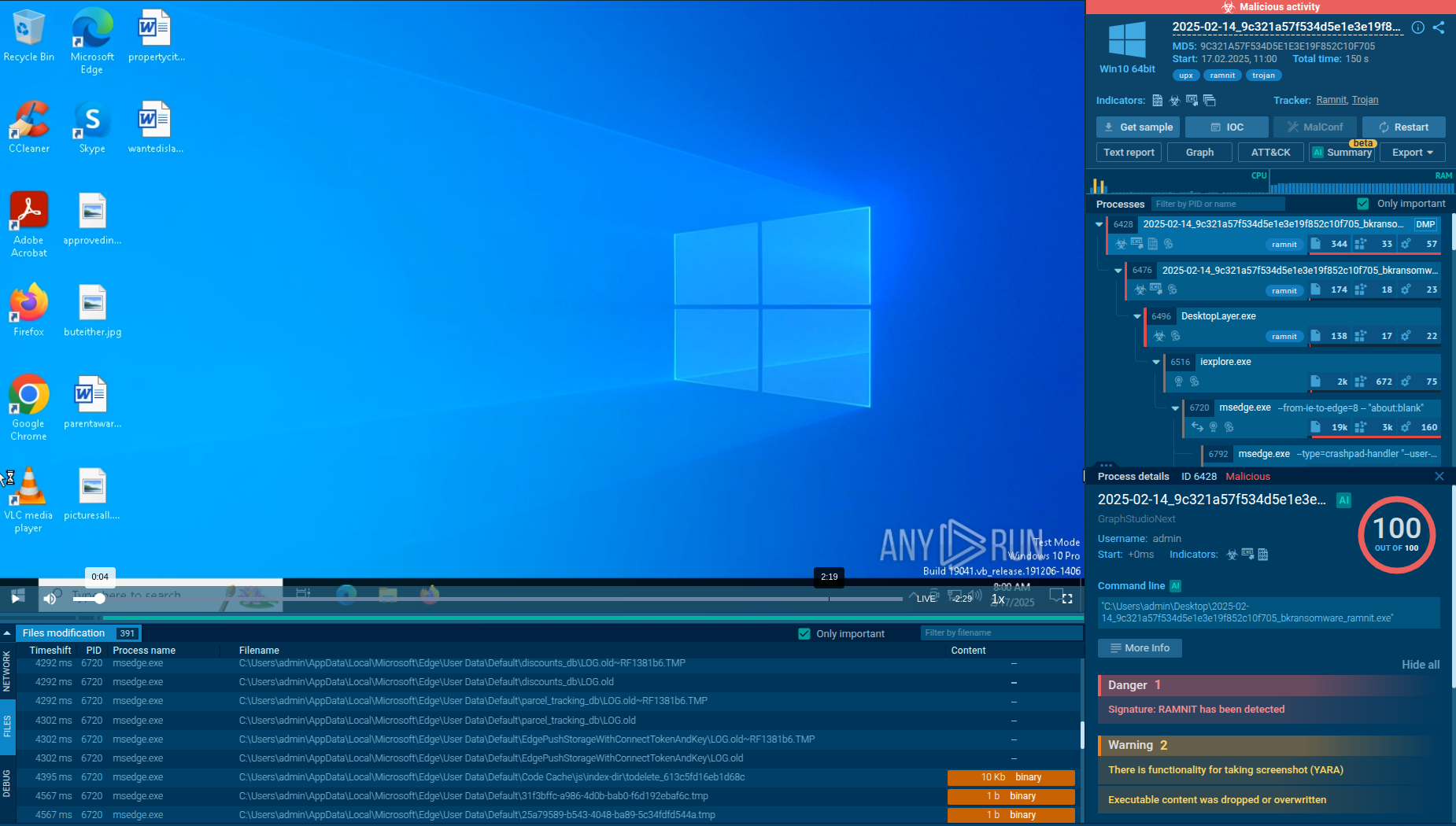
View Ramnit analysis inside ANY.RUN's Interactive sandbox
Ramnit infects and modifies files such as .dll, .exe, and .html on a system to spread itself and establishes backdoors for other malware, providing remote access to attackers. The infected endpoints are added to a botnet for coordinated attacks or further distribution of malware.
Ramnit allows attackers full system control over a device and further propagates through networks, escalating from a single machine infection to an organizational one.
Technical details of Ramnit malware
Ramnit is equipped with extensive malicious capabilities:
- Ramnit infects legitimate system files, ensuring it reloads on every reboot. It creates scheduled tasks or modifies registry keys like (HKCU\Software\Microsoft\Windows\CurrentVersion\Run).
- Man-in-the-browser (MitB) attacks are used to intercept online banking credentials.
- Fake login forms on legitimate banking sites are displayed via web injects.
- Ramnit can steal passwords stored in popular browsers including Chrome and Firefox and in Windows Credential Manager.
- Persistence is supported by infecting legitimate files, making removal difficult without damaging the OS.
- It logs keystrokes, captures screenshots, and uploads stolen data to C2 servers.
- Infected endpoints join a massive botnet used in DDoS attacks, spam campaigns, and further malware distribution.
- Uses SMB exploits and credential dumping techniques to spread across corporate networks.
Ramnit employs advanced evasion tactics to bypass detection: modifies its code to change its signature with each infection (polymorphism); runs within legitimate system processes (e.g., explorer.exe, svchost.exe); detects virtual machines; encrypts C2 traffic to avoid network detection; continuously generates new C2 domains.
The Execution process of Ramnit
To observe Ramnit’s activities in real time, we can detonate it in the safe environment of ANY.RUN’s Interactive Sandbox.
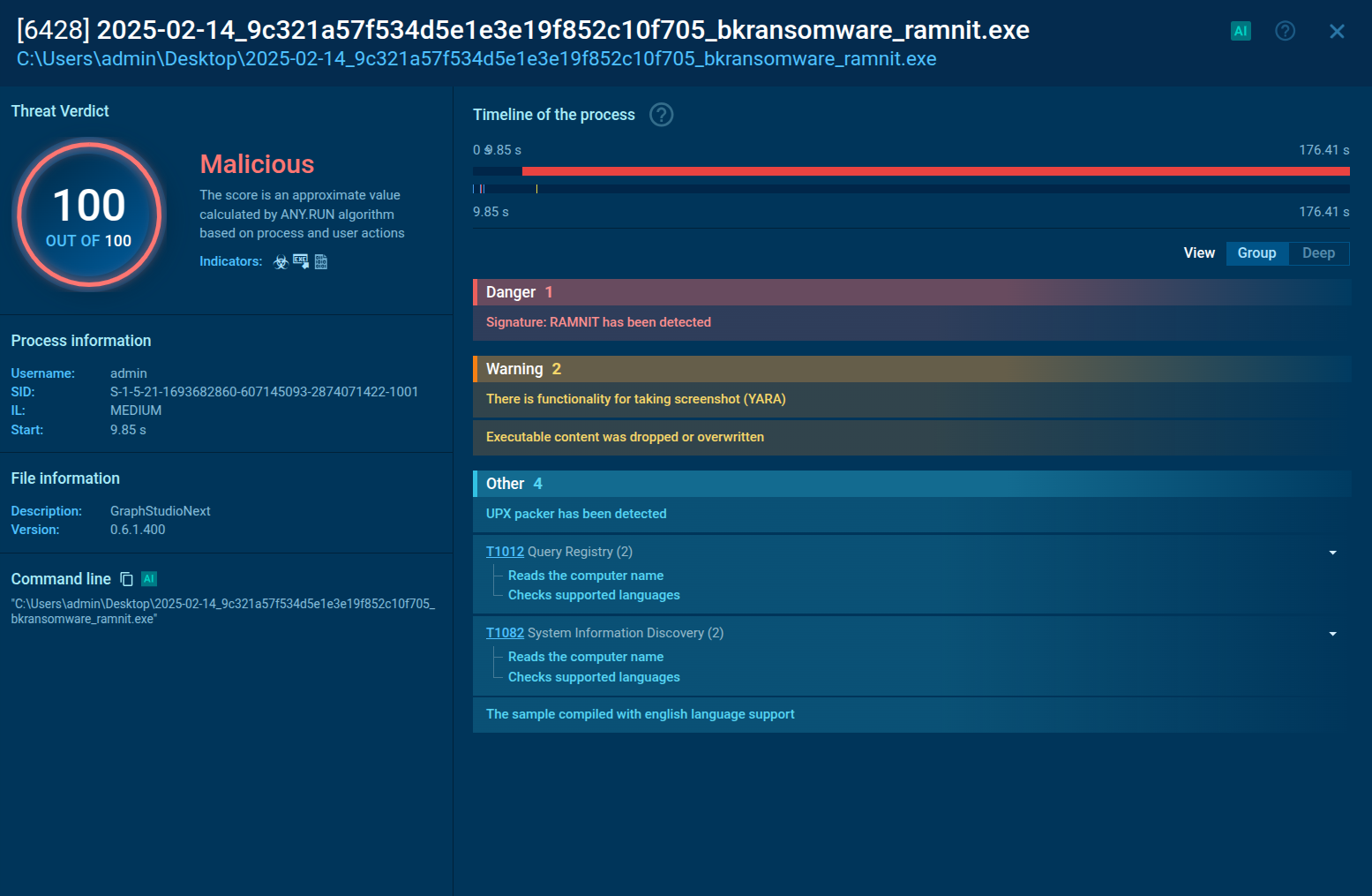
Ramnit typically spreads via phishing campaigns that use multi-stage malware. When a victim opens the initial payload, it downloads additional components and installs the Trojan. Once active, Ramnit harvests financial credentials and other sensitive data (e.g., social media and email).
After installation, Ramnit connects to its command and control (C&C) servers and often uses a domain generation algorithm (DGA), which creates random domain names to evade DNS blocklists. The C&C server uses the same DGA to register and manage these domains, making Ramnit harder to disrupt.
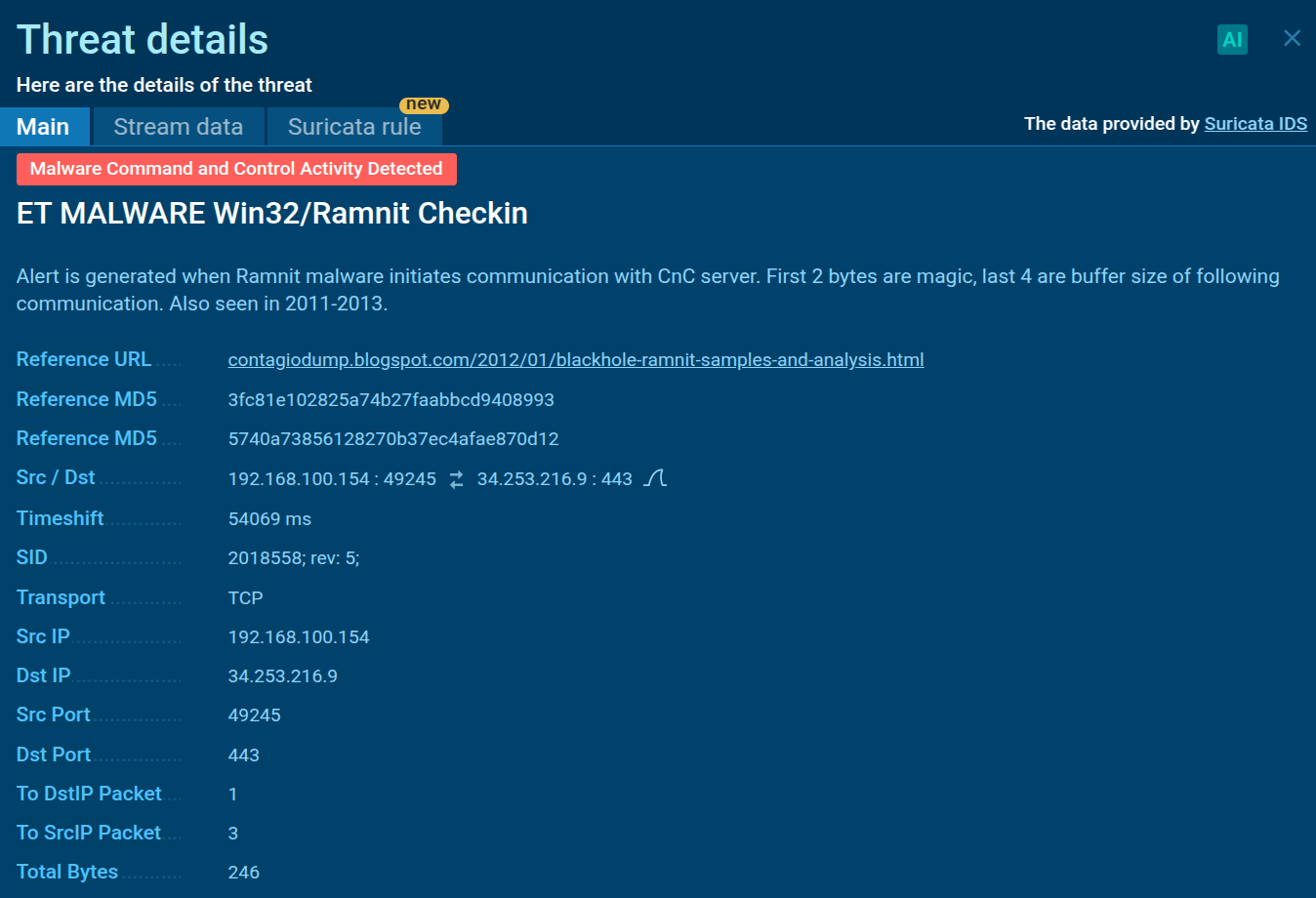
Ramnit’s modular design lets it download extra modules as needed. It can inject malicious code into browsers—often during online banking sessions — to steal data in real time. To evade detection, it uses techniques like process hollowing, injecting code into legitimate processes like “msiexec.exe” and “explorer.exe.” It can also fetch a VNC module for remote access.
Finally, Ramnit creates a proxy network of infected machines, relaying malicious traffic through multiple hosts to hide attacker activity. Overall, its execution chain relies on phishing-based distribution, DGA-powered C&C communication, modular expansion, and proxy networks to evade detection and facilitate broader attacks.
Gather Cyber Threat Intelligence on Ramnit Ransomware
Use Threat Intelligence Lookup to get a comprehensive picture of recent Ramnit activity and collect up-to-date indicators of the threat for setting up preemptive defenses. With over 40 search parameters, including IPs, domains, file names, and process artifacts, you can extract data from Ramnit malware samples analyzed in ANY.RUN's Interactive Sandbox by a huge community of security experts.
Leverage TI feeds to track C2 infrastructure, malware hashes, keep a watch over evolving tactics of Ramnit via MITRE ATT&CK mappings, and protect your business from financial and reputational loss.
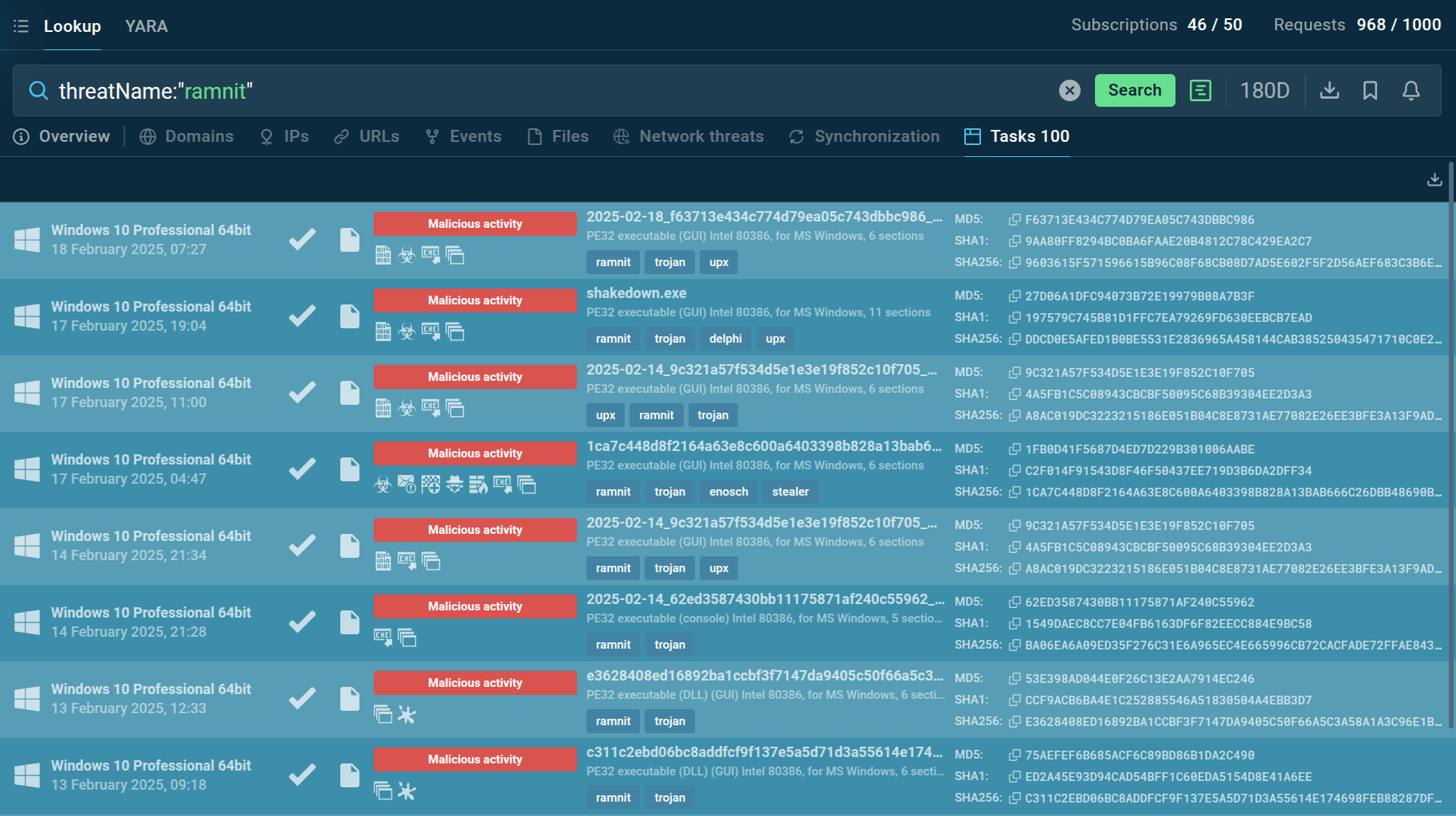
For example, submitting the query threaName:"ramnit" will provide you with the latest public sandbox reports on Ramnit samples.
Ramnit malware distribution methods
Ramnit spreads through multiple infection vectors, making it highly persistent and difficult to eradicate. It is delivered via phishing emails containing malicious Word, Excel, or PDF documents with embedded macros or exploit code. Users are infected when visiting compromised websites that host exploit kits targeting browser vulnerabilities.
Besides, Ramnit has been dropped by other malware families, including Emotet and Dridex, to expand its botnet.
It also can spread via USB drives, SMB shares, and network infections, bypassing internet defenses.
Conclusion
Hybrid capabilities of Ramnit make it an especially serious threat to organizations worldwide. It can function as a banking trojan, worm, RAT, and credential stealer simultaneously. To avoid suffering from Ramnit infection, make sure to introduce proper preventive security measures.
One of the essentials tools to help you identify Ramnit early is a malware sandbox. ANY.RUN provides an interactive malware sandbox that lets you safely detonate suspicious files and URLs in a fully functional virtual environment. The service helps you quickly detect cyber threats and collect critical data needed to prevent them from affecting your infrastructure.
Sign up for a free ANY.RUN account now to try advanced malware analysis.
Other malware & phishing threats
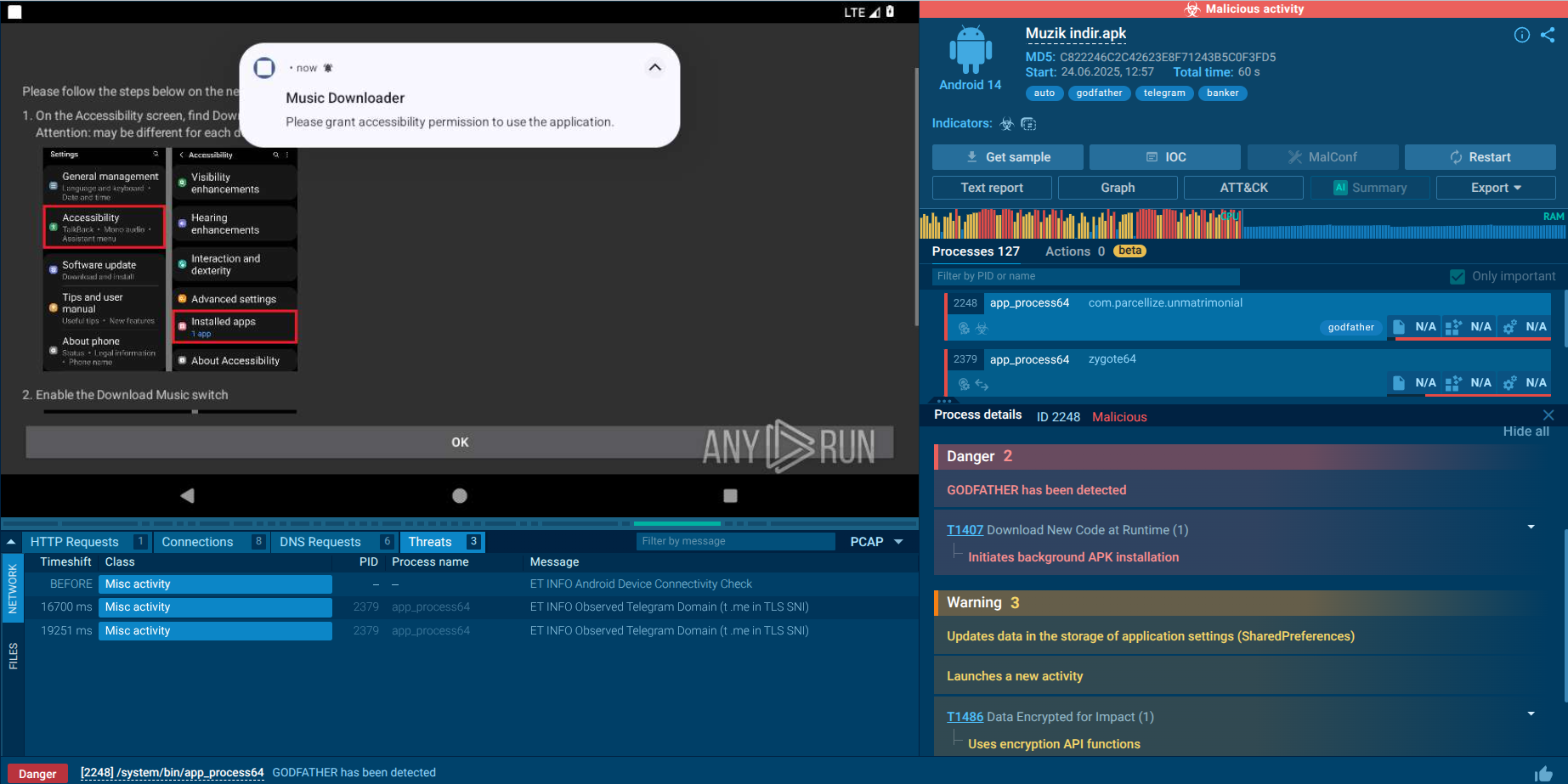 GodfatherThe Godfather malware is an Android banking Trojan capable of bypassing MFA that targets mobile banking and cryptocurrency applications. Known for its ability to evade detection and mimic legitimate software, it poses a significant threat to individuals and organizations by stealing sensitive data and enabling financial fraud.
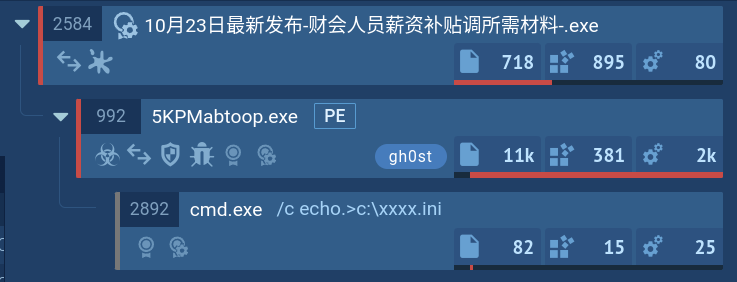 Gh0st RATGh0st RAT is a malware with advanced trojan functionality that enables attackers to establish full control over the victim’s system. The spying capabilities of Gh0st RAT made it a go-to tool for numerous criminal groups in high-profile attacks against government and corporate organizations. The most common vector of attack involving this malware begins with spam and phishing emails.
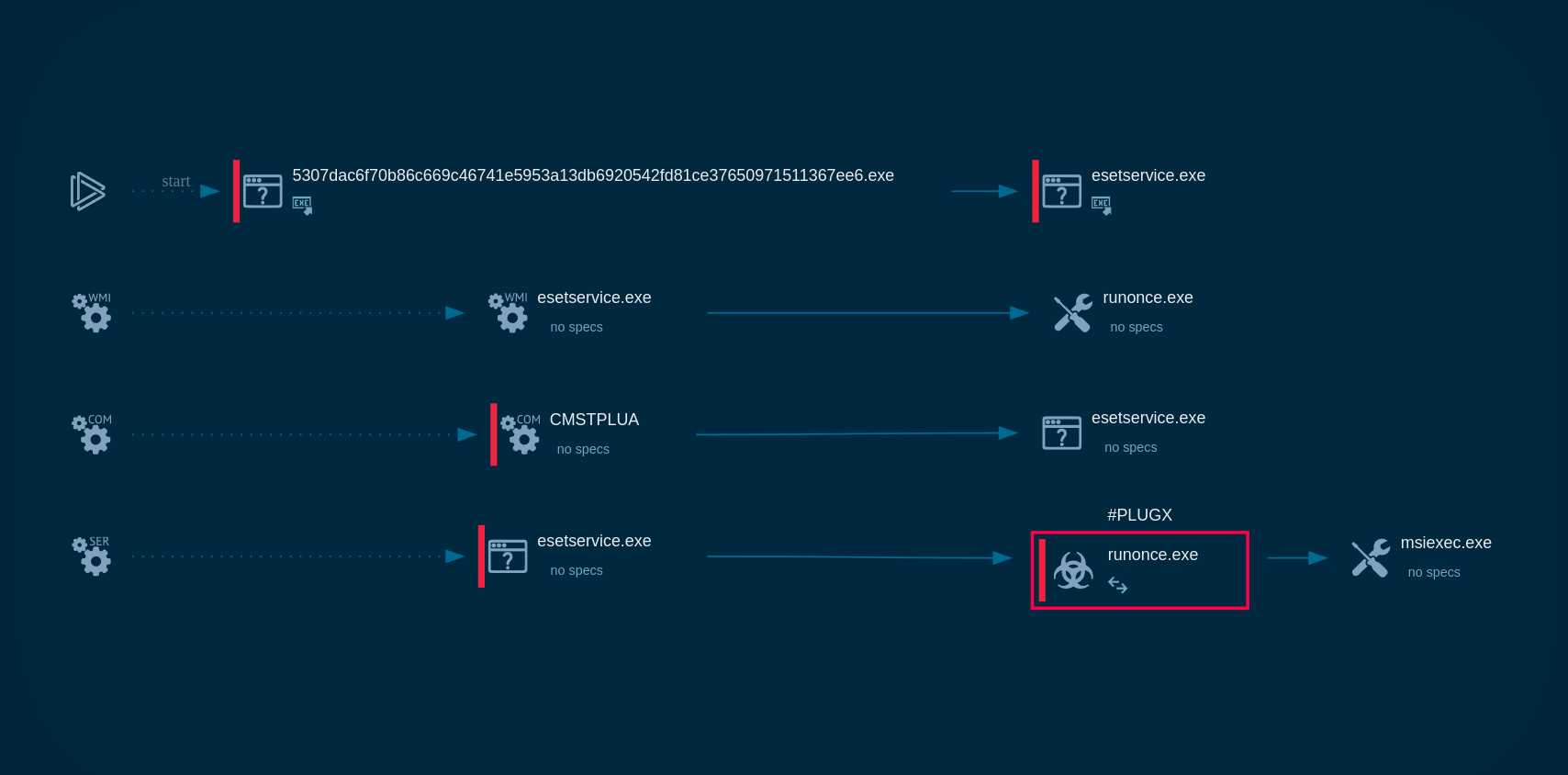 BackdoorA backdoor is a type of cybersecurity threat that allows attackers to secretly compromise a system and conduct malicious activities, such as stealing data and modifying files. Backdoors can be difficult to detect, as they often use legitimate system applications to evade defense mechanisms. Threat actors often utilize special malware, such as PlugX, to establish backdoors on target devices.
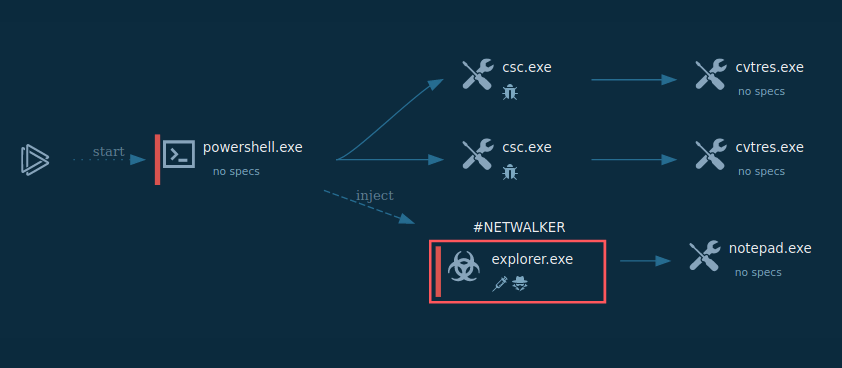 NetwalkerNetwalker is ransomware — it belongs to a malware family which encrypts files and demands users to pay a ransom to get their data back. Netwalker utilizes several sophisticated techniques, such as process hollowing and code obfuscation to target corporate victims.
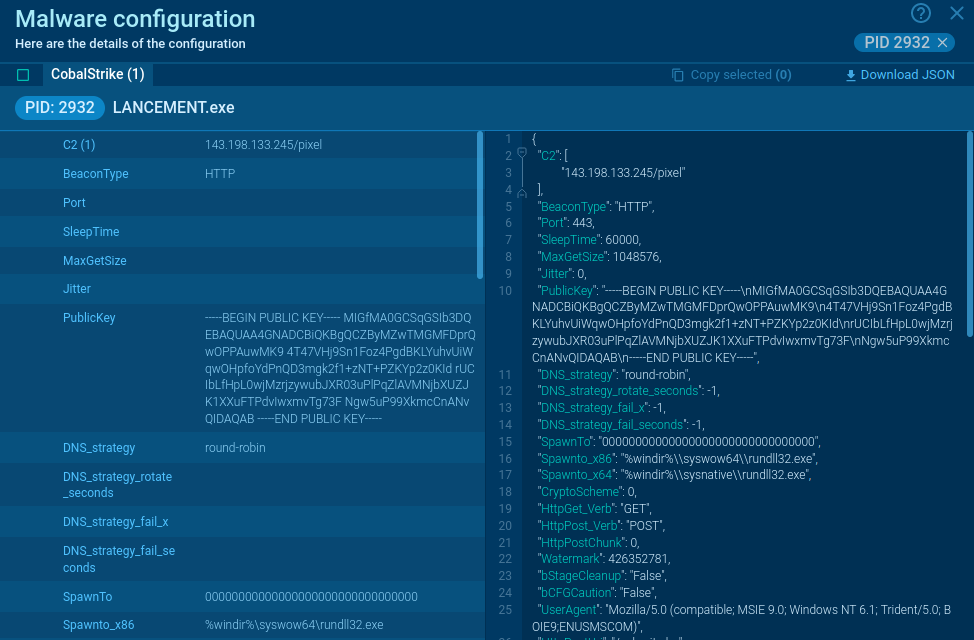 Cobalt StrikeCobalt Strike is a legitimate penetration software toolkit developed by Forta. But its cracked versions are widely adopted by bad actors, who use it as a C2 system of choice for targeted attacks.